University campuses today look quite different from what they did even a decade ago. Campuses are no longer just academic spaces where students attend lectures and return to hostels. They are dynamic ecosystems: housing thousands of students, faculty, administrators, vendors, and visitors every single day. With this growth comes a unique set of operational challenges: managing deliveries, storing equipment, enabling 24/7 access to shared resources, and doing all of this without increasing workforce or chaos.
This is where campus lockers, especially smart lockers, are quietly transforming how universities function.
While most people associate lockers on campus with parcel deliveries, modern university lockers go far beyond packages. When deployed strategically, they become shared infrastructure that multiple departments can use improving efficiency, security, and user experience across the board.
Let’s explore how campus lockers can serve different university departments and why smart locker systems are becoming a must-have for future-ready campuses.
The Shift from Traditional Lockers to Smart Campus Infrastructure
Traditional lockers served one purpose: static storage. They required keys, manual allocation, and constant supervision. Once assigned, they stayed locked to one person for an entire semester or year, whether they were used or not.
Smart lockers flip this model completely.
With digital access, real-time tracking, centralized dashboards, and flexible usage, smart lockers transform into shared, on-demand infrastructure. Instead of belonging to one person, lockers now belong to the campus, available to whoever needs them, whenever they need them.
This shift allows universities to unlock value far beyond mailrooms and parcel management.
Uses of Campus Lockers Beyond Traditional Storage
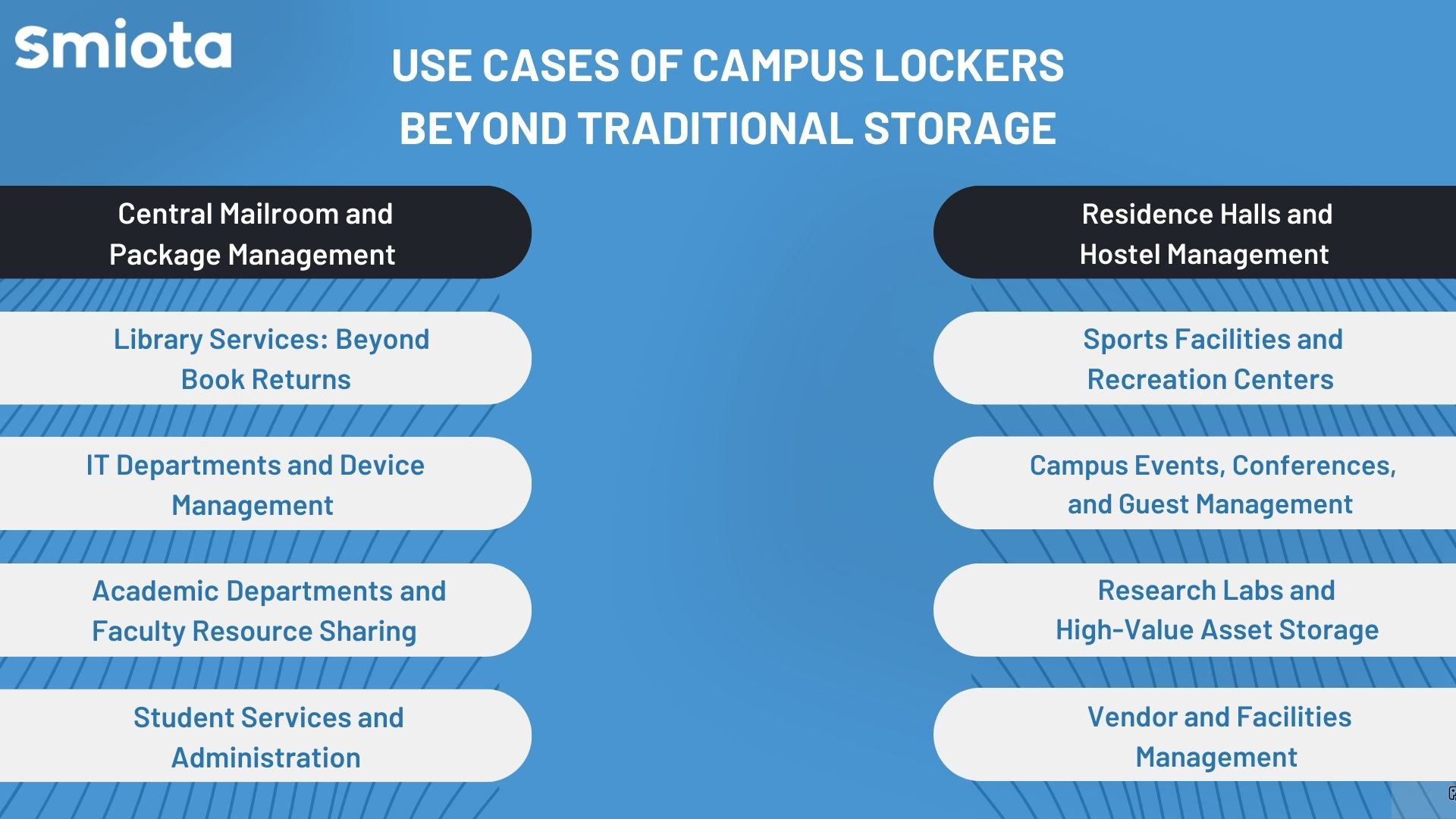
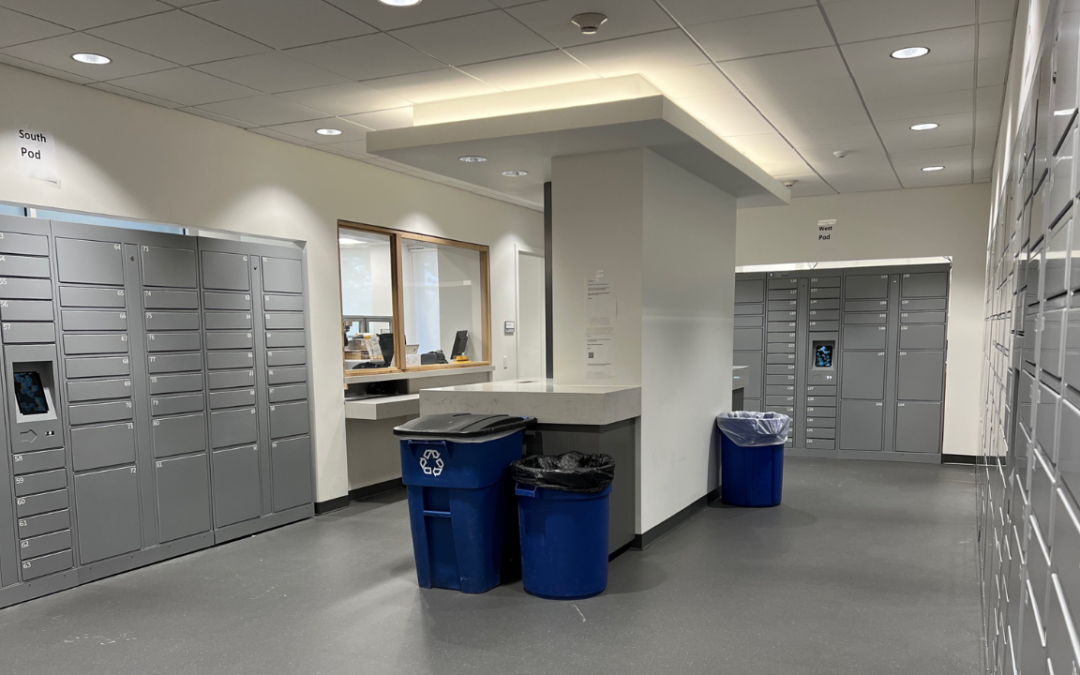
1. Central Mailroom and Package Management
Let’s start with the most obvious and widely adopted use case.
University campuses receive thousands of packages daily, online shopping orders, academic materials, lab supplies, personal deliveries, and vendor shipments. Managing these manually creates bottlenecks, misplaced parcels, and frustrated students.
By deploying campus lockers for package management, universities can:
- Enable 24/7 self-service parcel pickup
- Reduce staff workload at mailrooms
- Eliminate lost or delayed packages
- Improve student satisfaction instantly
Smart lockers notify recipients automatically, track every pickup, and ensure only authorized users access their items. But this is just the beginning.
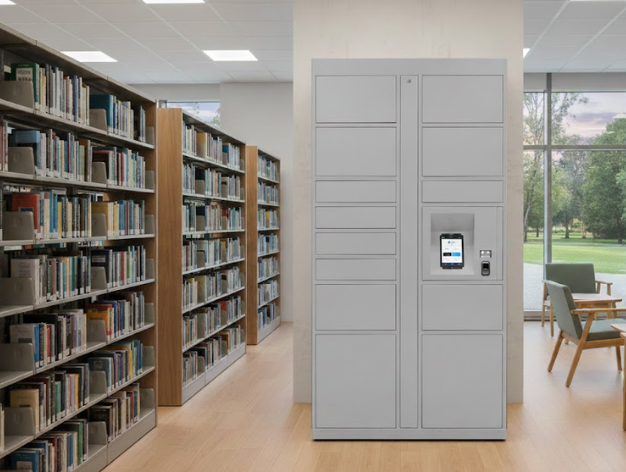
2. Library Services: Beyond Book Returns
Libraries are evolving too. They are no longer silent reading spaces, they are collaborative hubs with digital resources, devices, and extended hours.
University lockers can support libraries in several ways:
- Contactless book pickup and returns
- Reserved textbook distribution
- Laptop, tablet, and device lending
- Secure storage for inter-library transfers
Students no longer need to rush during limited library hours. Faculty can distribute reference materials securely, and library staff can manage circulation more efficiently without overcrowded counters. Smart lockers help libraries extend their services without extending staffing hours.
3. IT Departments and Device Management
Every campus IT team knows the pain of managing shared devices, laptops, tablets, chargers, routers, projectors, and accessories. Tracking who borrowed what, when it was returned, and whether it’s damaged can become a nightmare.
With smart lockers, IT departments can automate device check-in and check-out, track usage and availability in real time, reduce device loss and manual logging, and enable after-hours access for students and staff.
- Students can collect pre-booked devices using secure authentication, and IT teams get full visibility without standing behind a desk all day.
Also read: Using Smart Lockers for IT Asset Management
4. Academic Departments and Faculty Resource Sharing
Many academic departments handle physical resources, lab kits, instruments, course materials, models, and documents. Sharing these resources often involves emails, paper logs, or in-person handovers.
Campus lockers offer a smarter alternative.
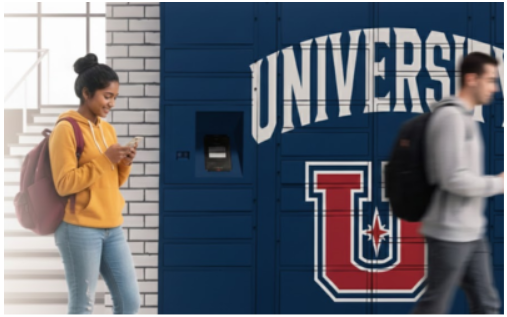
Departments can use campus lockers to distribute lab equipment for scheduled sessions, share department-owned tools across batches, store confidential academic documents, and enable faculty-to-student handoffs without face-to-face dependency.
- This approach reduces administrative friction and ensures accountability without micromanagement.
5. Student Services and Administration
Student services offices deal with a wide range of items such as ID cards, certificates, transcripts, forms, uniforms, welcome kits, and exam-related documents. Managing queues and appointment-based pickups slows everything down.
By integrating university lockers into student services, campuses can:
- Offer secure document pickup outside office hours
- Reduce queues during peak periods
- Ensure privacy and traceability
- Improve service delivery without expanding office space
Students appreciate flexibility, and administrative teams gain breathing room.
6. Residence Halls and Hostel Management
Hostels and residence halls operate like micro-campuses within the larger campus ecosystem. From maintenance tools to shared appliances, lost-and-found items to personal storage needs, hostel management requires constant coordination.
Smart lockers enable temporary storage for student belongings, secure storage for appliances, sports gear, and books, maintenance staff tool distribution, and efficient lost-and-found item management.
- For students, this means fewer disputes and safer storage. For administrators, it means smoother operations and better asset control.
7. Sports Facilities and RecreationCenters
University gyms, sports complexes, and recreation centers see high footfall every day. Managing day-use lockers, equipment lending, and staff coordination can be challenging.
Smart lockers allow:
- Day-use lockers without physical keys
- Automated sports equipment distribution
- Secure staff-only storage
- Reduced congestion at reception desks
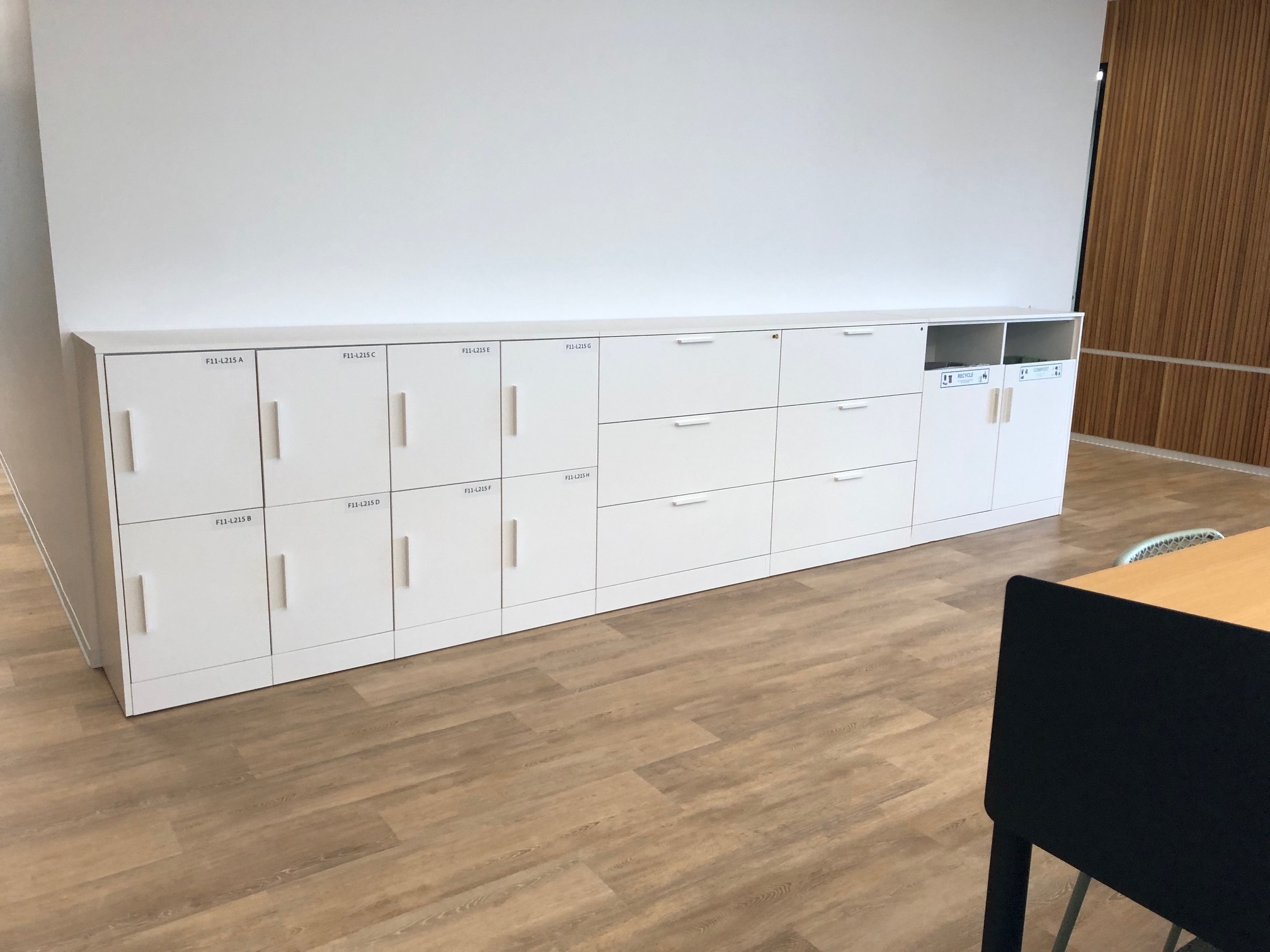
With smart access and usage logs, sports facilities become more efficient and user-friendly.
8. Campus Events, Conferences, and Guest Management
Universities frequently host conferences, workshops, alumni meets, and cultural festivals. Managing event kits, badges, merchandise, and speaker materials requires temporary but secure storage. Campus lockers support event material distribution, secure guest access without staff supervision, and post-event returns with inventory tracking. This is especially useful for large campuses hosting multi-day events.
9. Research Labs and High-Value Asset Storage
Research departments often deal with sensitive equipment, prototypes, samples, and documents. Traditional storage rooms don’t always provide traceability or controlled access.
Smart lockers offer controlled access to high-value assets, audit trails for compliance, reduced risk of loss or misuse, and secure storage to support cross-department collaboration. For research-intensive universities, this adds a strong layer of operational discipline.
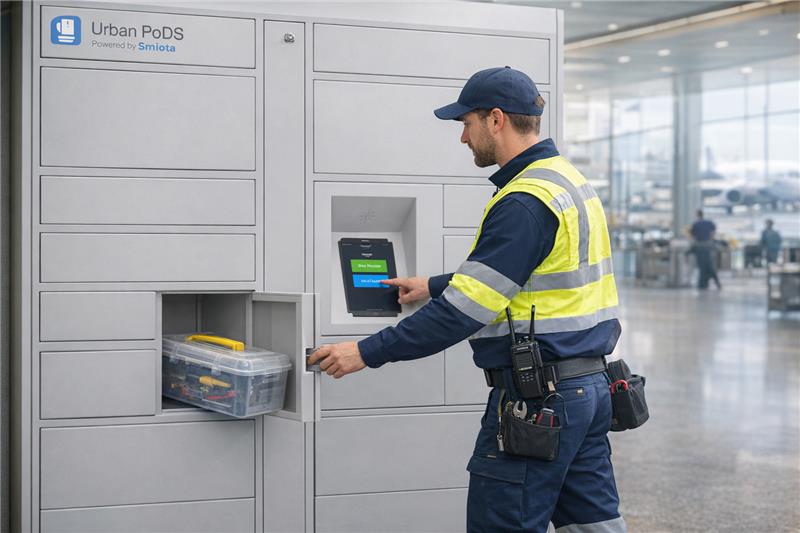
10. Vendor and Facilities Management
Vendors, maintenance teams, and service providers operate on different schedules. Coordinating access to tools, spare parts, and consumables can slow down response times.
With smart lockers, campuses can enable vendor pickups without supervision, store maintenance supplies securely, track usage across departments, and reduce downtime during repairs. Facilities teams gain speed without compromising security.
Why Smart Lockers Make Sense for Modern Campuses
The true value of smart lockers lies in their flexibility. Unlike traditional storage systems that serve a single purpose or department, smart lockers function as shared campus infrastructure that adapts to changing needs. A locker that handles parcels in the morning can just as easily store IT equipment in the afternoon or academic resources in the evening. This ability to serve multiple workflows from one system makes smart lockers a natural fit for modern university environments.
Smart lockers also significantly reduce the dependency on manual processes. Campuses no longer need staff to manage handovers, maintain paper logs, or supervise access throughout the day. Automated access control and real-time tracking ensure accountability while freeing up administrative teams to focus on higher-value tasks. For students and faculty, this translates into faster access, fewer delays, and the freedom to collect or return items on their own schedules.
Beyond convenience, smart lockers align closely with the digital transformation goals many universities are actively pursuing. They support contactless interactions, generate usage data that can inform better planning, and contribute to sustainability by reducing unnecessary travel, paper usage, and duplicated infrastructure. Smart lockers bring together efficiency, security, and user experience into one scalable solution that grows with the campus.
Why Universities Choose Smiota Smart Lockers
When universities invest in smart locker systems, they are not just choosing hardware; they are choosing a long-term operational partner. Smiota understands that campuses are complex ecosystems with diverse departments, fluctuating demands, and strict security requirements. That understanding is reflected in how Smiota designs its smart locker solutions to be modular, adaptable, and campus ready.
Whether lockers are deployed in libraries, hostels, IT departments, or administrative offices, they maintain consistent user experiences while supporting different use cases behind the scenes. Administrators gain centralized visibility and control, while students and staff enjoy intuitive, frictionless access.

Scalability is another reason universities choose Smiota. Campuses evolve, student populations grow, and new departments emerge. Smiota lockers are built to expand across buildings and functions without disrupting ongoing operations. With robust security, real-time monitoring, and the flexibility to support multiple departments through a single system, Smiota enables universities to move beyond isolated solutions and build a truly connected campus infrastructure.
Get in touch with us today to explore how smart lockers can enhance the operations of your university campus.
Final Thoughts
Campus lockers are no longer just about packages. They are becoming shared infrastructure that supports learning, collaboration, administration, and campus life as a whole.
From libraries and IT departments to hostels, sports facilities, and research labs, university lockers unlock efficiency across every corner of the campus. And when powered by smart technology, they transform everyday operations into seamless experiences.
For universities looking to future-proof their campuses, reduce operational friction, and improve student satisfaction, investing in Smiota smart lockers isn’t just a convenience, it’s a strategic move.
Because when one smart system can support every department, the entire campus moves forward together.