Walk through any university campus on a busy weekday and you will see the quiet chaos of logistics everywhere. Parcels piled up in mailrooms, students chasing missing deliveries, library books going unreturned, lab kits misplaced, and sports equipment stored wherever there is space. Behind the scenes, administrators are dealing with repeated deliveries, lost items, and constant replacements, often without real visibility into how much waste this creates.
As universities push toward sustainability goals, these everyday inefficiencies are becoming harder to ignore. This is where smart lockers step in, not just as a convenience feature, but as a practical, tech-driven solution to a much larger problem. Beyond simplifying storage and deliveries, smart lockers actively help reduce waste, cut down unnecessary transport, and lower carbon footprints. For campuses striving to become greener and more responsible, smart lockers are emerging as an essential part of sustainable infrastructure.
The Environmental Cost of Traditional Campus Logistics
Traditional campus logistics come with environmental costs that often go unnoticed. When packages are missed or misplaced, they are frequently returned to distribution centers, doubling transportation emissions for a single delivery. Multiply that by thousands of packages over a semester, and the carbon impact becomes significant.
The same applies to shared campus assets. Misplaced library books, lab equipment, or sports gear often lead to unnecessary replacements. Each replacement means new manufacturing, packaging, shipping, and eventually disposal, all contributing to increased landfill waste and resource depletion. Even temporary misplacement can cause departments to over-order “just in case,” adding to excess inventory that may never be fully used.
Fuel consumption from repeated campus delivery runs, maintenance trips, and internal transport adds another layer of emissions. Delivery vehicles idling, driving short inefficient routes, or making multiple attempts all increase CO₂ output. When combined with discarded packaging materials and damaged goods, traditional campus logistics quietly undermine sustainability efforts, despite good intentions.
Smart Lockers as a Solution to Reduce Waste
Smart lockers prevent waste by eliminating common points of loss and inefficiency on campus. Secure compartments, digital access controls, app notifications, and timed pickups ensure that items are stored correctly and collected on time, reducing uncertainty for both users and administrators. When items are less likely to go missing, campuses avoid unnecessary replacements and the waste that comes with them.
Examples of how smart lockers reduce waste on campus:
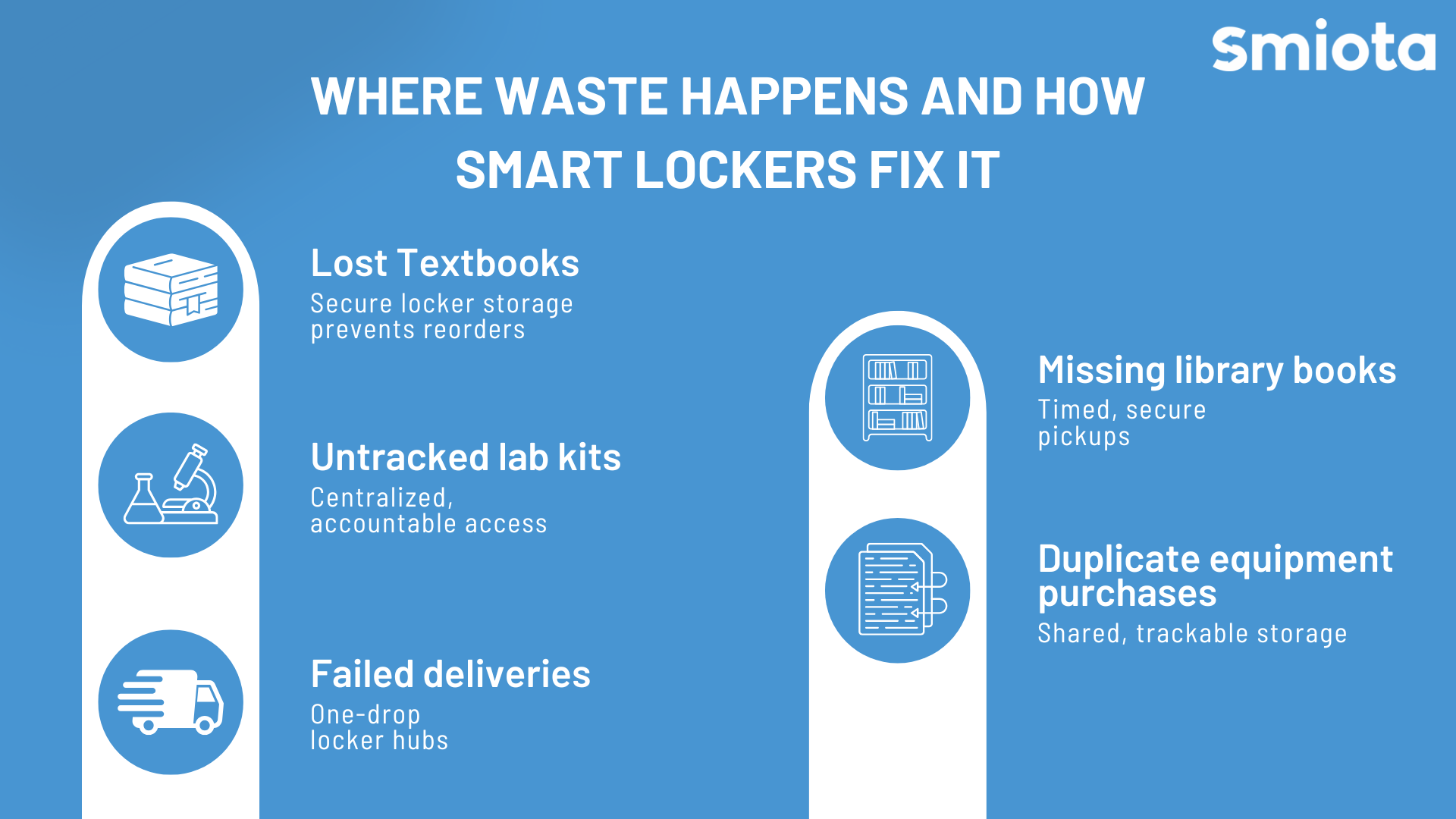
- Students no longer misplace textbooks, lab equipment, or project materials, cutting down on repeated purchases and replacements.
- Shared lab kits and academic resources remain tracked and accounted for, reducing overstocking and excess inventory.
- Centralized package deliveries into smart locker hubs reduce failed delivery attempts, returns, and damaged parcels.
- Library books and learning materials are securely stored for pickup, minimizing losses and replacement orders.
- Sports equipment, art supplies, or student organization materials are stored and retrieved efficiently, preventing duplicate purchases.
Every avoided replacement directly reduces environmental impact. Fewer replacements mean less manufacturing, reduced shipping and transport emissions, and lower disposal rates. Over time, smart lockers help campuses shift from waste-heavy, reactive systems to intentional, sustainable resource management.
Minimizing Carbon Footprint through Smarter Deliveries
One of the most direct sustainability benefits of smart lockers is their impact on delivery efficiency. Centralized locker hubs allow multiple deliveries to be completed in a single stop, rather than across scattered buildings or departments. This consolidation significantly reduces the number of delivery trips required across campus.
Fewer delivery attempts also mean fewer miles traveled. Missed deliveries are a major contributor to unnecessary emissions, and smart lockers eliminate this issue by ensuring secure, 24/7 access for recipients. Couriers no longer need to return multiple times or reroute packages.
In addition, reduced vehicle movement leads to lower fuel consumption, fewer emissions, and less congestion on campus. For universities tracking their carbon output, these incremental reductions add up quickly over the academic year.
Smart lockers also align seamlessly with broader campus sustainability initiatives. Whether a university is aiming to reduce Scope 3 emissions or promote greener operations, locker-based delivery systems integrate technology into environmental planning, making sustainability measurable rather than aspirational.
Also read: Beyond Packages: Multi-Department Uses for Campus Lockers
Supporting a Circular Economy on Campus
Beyond logistics, smart lockers open the door to circular economy within campus communities. They can act as secure hubs for sharing, reuse, and redistribution, encouraging students and staff to consume less and share more.
Universities can use smart lockers to facilitate book exchanges, lab kit reuse, or shared access to art supplies and sports equipment. Student-run marketplaces and sustainability initiatives can leverage lockers as pickup and drop-off points, reducing friction in peer-to-peer exchanges.
By making sharing easy and reliable, smart lockers reduce the demand for new products. Fewer purchases mean less manufacturing, lower transport emissions, and reduced landfill waste. Over time, this fosters a campus culture where reuse becomes normal rather than inconvenient.
The long-term impact goes beyond waste reduction. Students exposed to sharing systems during their education are more likely to carry sustainable habits into their professional and personal lives. Smart lockers, in this sense, become enablers of behavioral change, not just storage solutions.
Challenges and Considerations
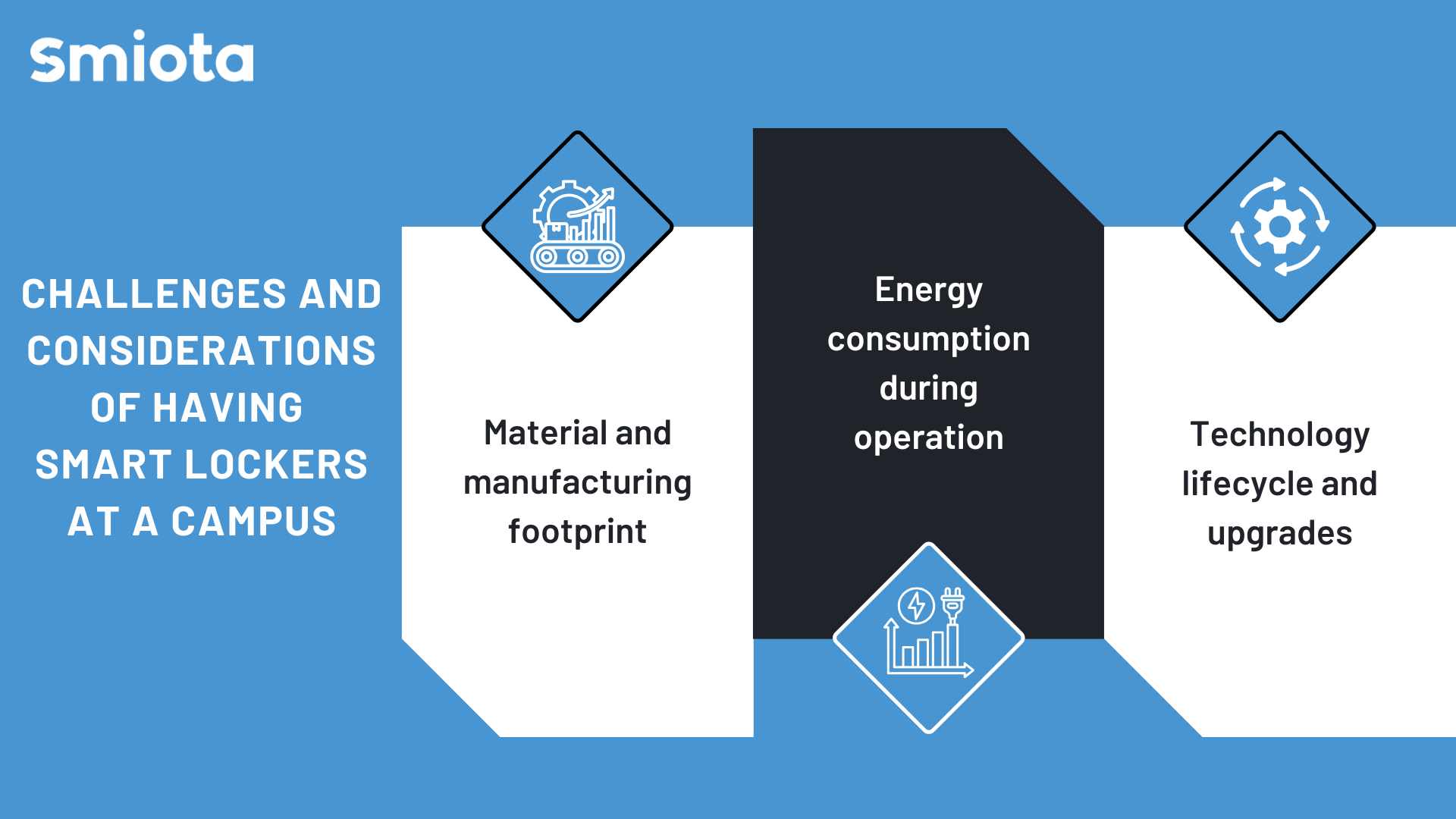
Like any infrastructure investment, smart lockers come with their own set of challenges. The key is not to overlook them, but to address them thoughtfully so sustainability goals remain intact from day one.
- Material and manufacturing footprint:
Manufacturing locker systems requires raw materials and energy, which can raise concerns about environmental impact. This can be mitigated by choosing lockers made from durable, recyclable materials and designs built for long-term use, reducing the need for frequent replacements.
- Energy consumption during operation:
Smart lockers rely on power for connectivity, access control, and notifications. Using energy-efficient components, low-power systems, and integrating lockers with renewable energy sources or energy-efficient campus grids helps significantly lower ongoing energy consumption.
- Technology lifecycle and upgrades:
Like all technology, smart lockers require maintenance, updates, and eventual upgrades. Opting for modular, scalable systems allows universities to upgrade individual components rather than replace entire units, extending the system’s lifecycle and minimizing waste.
When universities plan for these considerations early and view smart lockers as long-term infrastructure rather than quick fixes, the sustainability benefits far outweigh the initial footprint, making lockers a truly responsible investment for greener campuses.
Conclusion
Sustainable campuses are built through a series of practical, everyday decisions. Smart lockers play a powerful role in this journey by reducing waste, optimizing delivery logistics, and enabling sharing and reuse across campus communities. What might seem like a small infrastructure upgrade can create a ripple effect across sustainability goals, student behavior, and operational efficiency.
More importantly, smart lockers show how technology and sustainability can work together in meaningful ways. They are not just about convenience or efficiency. They represent smarter campus planning that aligns operational needs with long-term environmental responsibility.
Solutions like Smiota’s smart lockers are designed with this balance in mind. Built for durability, scalability, and real campus use cases, Smiota lockers help universities reduce unnecessary deliveries, prevent resource loss, and support circular practices, all while improving the day-to-day experience for students and staff.
As universities rethink how they manage resources, cut emissions, and engage students in sustainability efforts, smart lockers deserve a place in the conversation. Not as an add-on, but as a strategic investment in building greener, more resilient campuses for the future. Talk to us today to explore how you can use Smiota lockers to accelerate your sustainability goals.